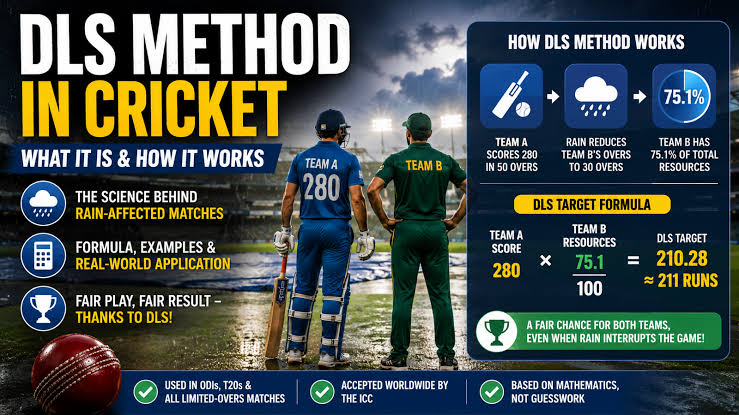
Duckworth-Lewis-Stern Method, commonly known as the DLS Method, is one of the most important rules in limited-overs cricket. Whenever rain or bad weather interrupts a One Day International (ODI) or T20 match, the DLS Method is used to calculate a revised target for the team batting second. Instead of simply reducing the target based on overs lost, DLS considers both the overs remaining and the wickets in hand to produce the fairest possible result.
If you’re passionate about cricket and enjoy reading sports guides, visit Notout Bd for more informative articles and updates.
What Is the Duckworth-Lewis-Stern Method?
The Duckworth-Lewis-Stern Method is a mathematical system used by the International Cricket Council (ICC) to revise target scores in rain-affected limited-overs matches. It was originally developed by statisticians Frank Duckworth and Tony Lewis, and later updated by Steven Stern in 2014, giving the system its current name.
The method is used only in:
- One Day Internationals (ODIs)
- Twenty20 (T20) matches
It is not used in Test cricket.
Why Was the DLS Method Created?
Before the DLS Method, cricket used much simpler rain rules that often produced unfair results. Teams could lose despite being in a stronger position simply because overs were reduced.
The ICC adopted the DLS Method because it provides a more balanced way to determine revised targets when weather interrupts play.
How the Duckworth-Lewis-Stern Method Works
The Duckworth-Lewis-Stern Method is based on two important resources every batting team has:
- Overs remaining
- Wickets remaining
A team with many overs left and several wickets available has more scoring potential than a team with only a few overs left or many wickets already lost.
The DLS calculation estimates how many “resources” remain and adjusts the target accordingly.
A Simple Example
Imagine Team A scores 280 runs in 50 overs.
Team B begins chasing the target, but after 20 overs rain interrupts the match. Officials reduce the innings to 35 overs.
Instead of simply reducing the target proportionally, the Duckworth-Lewis-Stern Method calculates:
- Overs remaining
- Wickets still available
- Scoring potential
A new target is then announced that reflects the reduced resources available to Team B.
Why Wickets Matter
Many people think only overs matter, but wickets are equally important.
For example:
- A team at 120/1 after 20 overs still has plenty of batting strength.
- A team at 120/8 after 20 overs has very limited scoring potential.
Because of this difference, the DLS Method treats these situations differently when calculating revised targets.
When Is the DLS Method Used?
The Duckworth-Lewis-Stern Method is applied when:
- Rain interrupts play.
- Bad light shortens the match.
- Other unexpected delays reduce the number of overs.
It is commonly seen during international tournaments, domestic one-day competitions, and T20 leagues whenever weather affects the schedule.
For more cricket-related content and sports insights, you can explore the NotOut BD Blog.
Advantages of the DLS Method
The DLS Method offers several benefits:
- Produces fairer revised targets.
- Considers both wickets and overs.
- Widely accepted by international cricket authorities.
- Reduces the impact of weather on match fairness.
Although the calculations are complex, computer software performs them instantly during professional matches.
Why Some Fans Find It Confusing
Many spectators become confused because the DLS formula itself is not shown during broadcasts.
Instead, scoreboards usually display:
- Revised target
- Par score
- Overs remaining
The detailed mathematical calculations happen behind the scenes using official ICC resource tables.
The Importance of the DLS Method in Modern Cricket
Without the Duckworth-Lewis-Stern Method, rain-affected matches could produce unfair outcomes. The system ensures both teams receive a fair opportunity based on the resources available, making limited-overs cricket more balanced and competitive.
Whether it’s a major ICC tournament or a domestic T20 competition, DLS has become an essential part of modern cricket whenever weather interrupts play.
Fans interested in following more cricket coverage can also visit the Cricket Section at notout cricket betting for match-related content. Football enthusiasts can explore additional sports updates through notout football betting.
FAQ
What does DLS stand for?
DLS stands for Duckworth-Lewis-Stern, the official system used to revise targets in rain-affected limited-overs cricket matches.
Is the DLS Method used in Test cricket?
No. The DLS Method is only used in limited-overs cricket, including ODIs and T20 matches.
Why does DLS consider wickets?
Because wickets represent a team’s remaining batting resources. A team with more wickets can usually score faster in the remaining overs.
Who created the DLS Method?
The original method was developed by Frank Duckworth and Tony Lewis. Steven Stern later updated the model, leading to the current Duckworth-Lewis-Stern Method.






























/https%3A%2F%2Fsportsmole-media-prod.s3.gra.io.cloud.ovh.net%2F25%2F13%2Fendrick.jpg)